"Security testing" is one of those phrases that everyone in software has heard, nodded along to, and quietly hoped nobody would ask them to define. It shows up in sales calls, compliance checklists, and procurement questionnaires. And yet, if you stopped ten engineers in a corridor and asked what it actually means, you'd get ten slightly different answers, most of them gesturing vaguely at "hacking" or "that scan we run sometimes."
That fuzziness is a problem, because security testing is increasingly the thing standing between a software company and its next contract. Buyers want proof. Auditors want evidence. And the engineers building the product want a clear, jargon-free picture of what they're being asked to do and why.
This guide fixes the definition. It walks through what security testing actually is, why it's now effectively mandatory, the main types you'll encounter, who performs it, and how to start, in plain English, with no assumed background. By the end you'll be able to define the term crisply and know exactly where each piece fits.
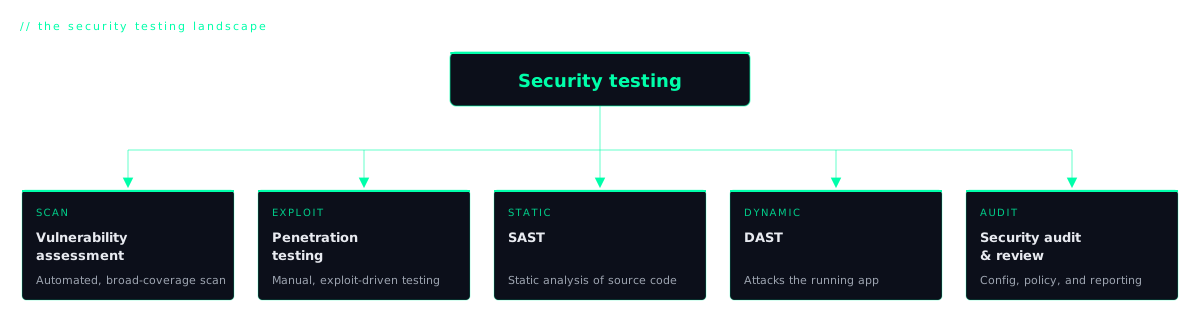
What Security Testing Actually Is
Security testing is the practice of deliberately evaluating software, systems, and infrastructure to find the weaknesses an attacker could abuse, and finding them before the attacker does. That's the whole idea in one sentence. You take the same posture an adversary would, probe the system for flaws, and report what you find so it can be fixed while it's still cheap and private rather than expensive and public.
It is distinct from functional testing. Functional testing asks "does the feature do what it's supposed to do?" Security testing asks "can the feature be made to do something it was never supposed to do?" A login form might pass every functional test (correct credentials let you in, wrong ones don't) while still being trivially bypassable by an attacker who manipulates the request in a way the developers never anticipated.
The practice spans a wide spectrum. At one end sits automated scanning: tools that crawl an application or network and flag known vulnerable components, missing patches, and common misconfigurations at speed. At the other end sits manual penetration testing: a skilled human reasoning about business logic, chaining small flaws into serious compromises, and finding the bugs no scanner can. Most mature programmes use both: automation for breadth and consistency, humans for depth and judgement.
Why Security Testing Is Required
For years, security testing was treated as optional, something you got to "once the product was stable." That era is over. Three forces have turned it into a baseline requirement.
1. Customers now demand evidence before they sign
Enterprise and Western clients no longer take "we take security seriously" at face value. Procurement teams send security questionnaires, and a growing number will not sign until they have seen a recent, independent test report. For a vendor selling into the US, UK, or EU, a clean penetration test report has become part of the sales kit, as expected as a pricing sheet. No report, no deal.
2. Compliance frameworks require it
Most of the standards a software company eventually has to meet (SOC 2, ISO 27001, PCI DSS, and others) explicitly call for periodic vulnerability assessment and penetration testing. Auditors ask for the evidence directly. You cannot pass these audits on documentation alone; you need real test results, produced on a regular cadence, demonstrating that you actively hunt for and remediate weaknesses.
3. Breaches are expensive
The cheapest bug to fix is the one you find yourself, in private, before it ships. The most expensive is the one an attacker finds in production. Beyond the direct cost of incident response, a breach brings regulatory penalties, customer churn, contractual liability, and reputational damage that can outlast the technical fix by years. Security testing is, fundamentally, a cost-avoidance exercise: a modest, predictable spend that heads off an unpredictable and potentially catastrophic one.
The Main Types of Security Testing
"Security testing" is an umbrella term covering several distinct activities, each suited to a different target and goal. Here are the ones you'll actually encounter, with a pointer to a deeper dive on each.
Vulnerability Assessment vs Penetration Testing
These two are constantly conflated, but they answer different questions. A vulnerability assessment (VA) is broad and largely automated: it enumerates known weaknesses across a system and produces a prioritised list. A penetration test (pentest) is narrower and human-driven: a tester actively exploits weaknesses to prove real impact and uncover the logic flaws scanners miss. VA tells you what might be wrong; a pentest proves what an attacker could actually do. For a full breakdown, see penetration testing vs vulnerability assessment.
Application Security Testing (SAST / DAST / black box)
Application security testing focuses on the code and runtime behaviour of software. SAST (static analysis) inspects source code without running it, catching flaws early in development. DAST (dynamic analysis) tests the running application from the outside, the way an attacker sees it, with no access to the source (a "black box" view). The two are complementary: SAST finds insecure patterns in code, DAST finds exploitable behaviour in the live system. See SAST vs DAST application security testing for how to combine them.
Web Application Security Testing
The web app is where most modern attacks land, because it's the part of your system exposed to the entire internet. Web application security testing targets the flaws specific to that surface (broken access control, injection, authentication weaknesses, and the rest of the OWASP catalogue) usually through a mix of automated scanning and manual exploitation. It's the single most common engagement a SaaS company commissions. Read more in web application security testing.
API Security Testing
APIs now carry the bulk of the traffic in most applications, and they fail differently from the web UIs in front of them. API security testing probes endpoints for broken object-level authorisation, excessive data exposure, missing rate limits, and authentication gaps, issues a UI-focused test will often walk straight past. If your product is API-first or backs a mobile app, this matters a great deal. See what is API security testing.
Security Audit & Reporting
Testing only delivers value if its findings are captured, prioritised, and communicated in a form your team (and your auditors) can act on. A structured security audit and report ties the technical findings to business risk, ranks them by severity, and gives clear remediation guidance, plus the evidence document that buyers and compliance frameworks ask to see. Learn more about our security audit & reporting service.
Network, cloud, and mobile testing
Beyond the application, the rest of your stack needs testing too. Network penetration testing probes your servers, firewalls, and exposed services for misconfigurations and weak points. Cloud penetration testing targets the identity, storage, and configuration flaws specific to AWS, Azure, and GCP environments. And mobile penetration testing covers the distinct risks of iOS and Android apps, from insecure local storage to weak certificate handling. Which of these you need depends entirely on your attack surface.
Who Performs Security Testing?
Security testing is carried out by people in defined roles: penetration testers (who actively attack systems to prove impact), security analysts (who assess findings, triage risk, and guide remediation), and the broader security-engineering function that bakes controls into the product. These people may sit inside your company or be brought in from outside, and that distinction matters more than it first appears.
In-house security engineers know your systems intimately, can test continuously, and integrate tightly with the development team. That depth of context is genuinely valuable. But it comes with a blind spot: it's very hard to find the flaws in a system you designed, because you carry the same assumptions that created them. Internal teams also face an obvious incentive problem: being asked to grade your own homework.
Independent third-party testers arrive with fresh eyes, no inherited assumptions, and no stake in the outcome. This is precisely why buyers and auditors specifically want independent testing: a report from the team that built the product carries far less weight than one from an external party with no reason to soften the findings. Compliance frameworks frequently mandate this independence outright. The strongest programmes use both: internal teams for continuous coverage, external testers for the credible, arm's-length validation that customers and auditors will actually accept.
How to Start Security Testing
If you've never run a formal security testing programme, the path is more approachable than it looks. A pragmatic sequence:
- Inventory your attack surface. You cannot test what you don't know exists. List every domain, subdomain, API, exposed service, and third-party integration. Shadow assets (that forgotten staging server, the old marketing site) are where breaches start.
- Run a baseline vulnerability scan. An automated scan across that surface gives you a fast, cheap map of the obvious problems: missing patches, outdated components, exposed admin panels, glaring misconfigurations.
- Fix the obvious first. Clear the low-hanging fruit the scan surfaces before you bring in a human. There's no value in paying a skilled tester to rediscover an exposed
.envfile you could have closed in an afternoon. - Commission a manual pentest of your most sensitive application. Once the noise is gone, have an independent tester go deep on whatever holds your most critical data, typically the customer-facing app or the API behind it. This is where business-logic flaws and chained exploits get caught.
- Bake testing into the SDLC. Make it continuous rather than a once-a-year scramble. The earlier and more routinely you test, the cheaper every fix becomes.
If you're not sure which engagement fits where you are today, our full range of services maps to each of these steps.
Where Security Testing Fits in the SDLC
The modern principle is shift-left: move testing as early in the software development lifecycle as you can, because a flaw caught in a developer's editor costs a fraction of the same flaw caught in production. Security testing isn't a single gate at the end: it's a series of checkpoints woven through the whole lifecycle.
In practice that looks like: SAST running in CI, scanning every commit for insecure code patterns before they merge; DAST running against staging, exercising the deployed application the way an attacker would before it reaches users; and a manual penetration test before a major release, the human-led, independent deep-dive that validates everything the automation can't reason about. Each layer catches what the previous one missed, and together they turn security from a last-minute panic into a steady, predictable discipline.
Where to go next
Security testing stops being intimidating the moment you can name its parts. It's the practice of finding your weaknesses before an attacker does, required now by customers and compliance alike, delivered through a handful of distinct test types, and best performed by independent specialists as a continuous part of how you build.
From here, pick the thread that matters most to you: understand the core distinction in penetration testing vs vulnerability assessment, get hands-on with code-level testing in SAST vs DAST, or go deep on the surfaces that matter most via web application security testing and API security testing. Each one builds on the foundation laid out here.