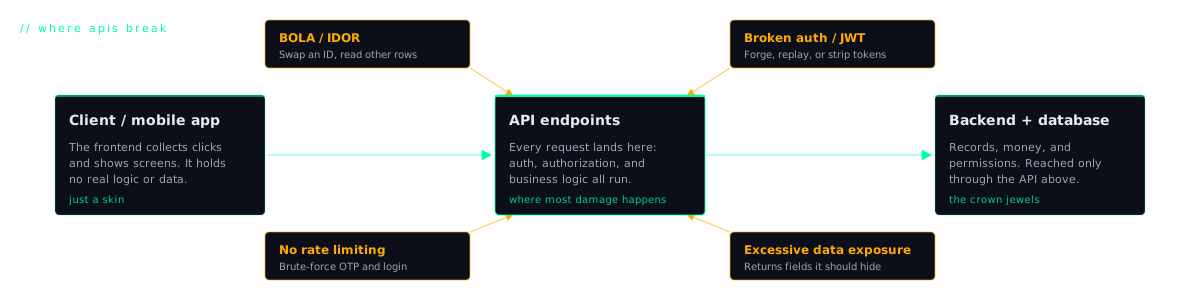
Open up almost any modern application and pull back the curtain, and you'll find the same shape underneath: a thin frontend (a React or Vue single-page app, or a native mobile client) that doesn't actually do very much. It renders screens, collects clicks, and validates the odd form field. The real logic, the data, the money, the permissions: all of that lives somewhere else entirely, behind an API.
That architectural shift has quietly rewritten where attacks happen. For years we talked about "web application security" as if the browser was the thing you defended. But the browser UI is no longer the boundary. It's a convenience layer for humans, and attackers are not humans clicking buttons. They're sending raw HTTP requests to the API directly, skipping every guardrail your frontend politely enforces.
So when people ask "why do we do API testing in cyber security?", the honest answer is: because that's where the application actually lives now. If you test the UI and not the API, you've tested the lobby and left the vault unlocked. This guide walks through what API security testing is, what gets tested, and why it's a genuinely different discipline from classic web app testing. (For the wider context of where API testing fits in the wider security testing picture, start there and circle back.)
What Is API Security Testing?
API security testing is the practice of testing your API endpoints directly (REST, GraphQL, gRPC, whatever you ship) for the flaws that let an attacker read data they shouldn't, perform actions they shouldn't, or break the business logic that's supposed to constrain them.
Concretely, a tester sits between "authenticated user" and "the data" and probes four broad areas on every endpoint:
- Authorization: given a valid token, can this user reach objects and functions that belong to someone else?
- Authentication: are tokens issued, validated, and expired correctly, or can they be forged, replayed, or stripped?
- Input handling: does the endpoint trust fields it shouldn't, or pass user input into queries and commands unsafely?
- Business logic: does the sequence of allowed actions create an outcome that was never intended (negative quantities, skipped payment steps, abusable workflows)?
The defining characteristic of good API testing is that it is done largely by hand, with multiple test accounts, not just by pointing a scanner at a base URL. A scanner can tell you a header is missing. It cannot tell you that User A's token can read User B's bank details, because it has no idea who is supposed to read what. That judgement is the whole job.
Why APIs Are the Biggest Attack Surface Now
A web UI hides things. If a feature isn't meant for you, the button simply doesn't render. That's not security, but it does keep casual users out. Most people never see what they can't click.
APIs hide nothing. Every endpoint is just a URL and an HTTP method, and there is no "button" to remove. If GET /api/v1/invoices/1043 returns your invoice, then GET /api/v1/invoices/1044 is one keystroke away, and if the server doesn't check ownership, it cheerfully returns the next tenant's invoice. One swapped ID can leak another customer's entire dataset. The frontend never offered that action, but the API doesn't know or care that the frontend exists.
Mobile makes this sharper still. A mobile app ships the API contract to every single user's device. Anyone can put a proxy in front of their own phone, watch every request the app makes, and learn the complete shape of your API: endpoints, parameters, auth scheme, the lot. There is no "private" mobile API; there is only an API you've handed to the public with a nicer skin on top.
What Gets Tested in an API Pentest
A real API pentest works through a well-defined catalogue of failure modes. Most of them map directly onto the OWASP API Security Top 10, which is the industry-standard reference for this class of bug. The headline categories we test for:
Authorization flaws (the big ones)
- BOLA / IDOR (Broken Object Level Authorization): swapping an object ID and reaching data you don't own. This is the single most common and most damaging API bug.
- BFLA (Broken Function Level Authorization): calling an admin-only or privileged function as a regular user because the endpoint never checks your role.
Authentication and data flaws
- Broken authentication / JWT issues: weak signing secrets,
alg:noneacceptance, tokens that never expire, missing validation. - Mass assignment: sending extra fields like
"role":"admin"or"is_verified":truethat the API binds straight onto the object. - Excessive data exposure: an endpoint returns the full database object and trusts the frontend to hide the sensitive fields it shouldn't have sent at all.
Abuse and inventory flaws
- Lack of rate limiting: no throttling on login, OTP, or password-reset endpoints, turning a 6-digit code into a guessable one.
- Injection: SQL, NoSQL, or command injection where input flows into a query or shell.
- Improper inventory management: forgotten
/api/v1/endpoints still live after/api/v3/shipped, or staging APIs reachable from the internet (shadow and old API versions).
Each of these deserves more than a bullet point. For the full breakdown of how these categories play out (and which ones executives consistently underestimate), see our deep dive on the OWASP API Security Top 10 for CTOs.
How API Testing Differs From Web App Testing
If you've been through a web application pentest, you might assume API testing is just a subset. It overlaps, but the workflow is genuinely different.
There's no rendered UI to crawl. In web app testing, a tool can spider links, fill forms, and discover pages by following the site. An API has none of that. You can't "browse" an API. Instead, the tester works from a specification (an OpenAPI/Swagger document or a Postman collection) or, when no spec exists, by capturing live traffic from the real client through a proxy and reconstructing the surface request by request.
Auth is token-based, not session-based. There's usually no cookie jar and no login form to fill. You're attaching bearer tokens or API keys to each request, and a big part of the test is what happens when you manipulate, swap, downgrade, or remove those tokens.
The same endpoint must be tested as many identities. This is the crux. A single endpoint like GET /api/orders/{id} isn't one test: it's a test as Tenant A, as Tenant B, as an admin, as an unauthenticated caller, and as a low-privilege role, each time checking whether the response is what that identity should be allowed to see. The endpoint is fixed; the identity is the variable.
Automated Scanners vs Manual API Testing
Automated scanners are useful. They find missing security headers, known-vulnerable components, obvious injection points, and TLS misconfigurations quickly and cheaply. Run them. They catch the boring stuff.
But the most damaging API bugs are precisely the ones scanners cannot find. BOLA, BFLA, mass assignment, business-logic abuse: every one of these is an authorization or logic question, and authorization is contextual. A scanner sees GET /api/invoices/1044 return a 200 OK and concludes the endpoint works. It has no way of knowing that the token it used belongs to a customer who should never see invoice 1044. It doesn't understand who should access what, so it cannot detect that the wrong person just did.
A human with two accounts does exactly that. They log in as Tenant A, capture every request, then replay each one with Tenant B's token and Tenant A's IDs. Anything that returns data instead of a 403 is a finding. That comparison (same request, different identity) is something a person reasons about in seconds and a scanner cannot reason about at all. This is why credible API testing is human-led, with automation as a first pass rather than the whole engagement.
How to Get Started
You don't need a security team to make real progress before you commission a test. The highest-leverage moves are mostly hygiene:
- Document every endpoint. Maintain an accurate OpenAPI spec or Postman collection. You cannot secure an inventory you don't have, and the forgotten endpoints are usually the dangerous ones.
- Enforce authorization server-side, on every object. Every request that touches a record must verify that the caller owns or is permitted that specific record, not just that they're logged in. Never trust an ID the client sends as proof of ownership.
- Add rate limiting. Throttle authentication, OTP, password-reset, and any expensive or enumerable endpoint. This shuts down brute force and a lot of scraping for almost no engineering cost.
- Then commission a manual API pentest. Once the obvious gaps are closed, bring in a tester with multiple accounts to find the authorization and logic flaws your own team can't easily see in their own design.
If you want that last step done properly, our API security testing service is built around exactly this: real endpoints, multiple test identities, and a human looking for the authorization bugs that matter.
The short version
The application moved behind the API, so the attack surface did too. API security testing is how you check the door everyone actually walks through now, by sending real requests, as different users, and seeing who gets let in. Scanners can warm up the engagement; people win it. Document your endpoints, enforce authorization on every object, throttle what can be brute-forced, and then have someone try to break it on purpose, before someone else does it for free.