If you've ever sat in a meeting where someone said "we run SAST in the pipeline but we still need DAST and probably a grey-box pentest before the SOC 2 audit," and quietly nodded while having no idea what half of that meant. You are in good company. The acronym soup of application security is genuinely one of the most confusing parts of the whole field, even for experienced engineers.
The confusion isn't your fault. Vendors invented overlapping categories to sell overlapping products, the abbreviations all look the same (SAST, DAST, IAST, SCA), and the older terms (black box, white box, grey box) describe the same activities from a completely different angle. So you end up with two vocabularies for one problem, nobody defines their terms, and everyone assumes everyone else already knows.
This post untangles all of it in plain English. By the end you'll know exactly what each acronym means, which ones overlap, when each one runs, and (the part that actually matters) where automated tools stop and a human penetration tester has to take over.
What Is Application Security Testing?
Application security testing means testing a specific application (a web app, an API, a mobile app, a desktop client) for flaws that an attacker could exploit. That's the distinguishing word: application. It's deliberately narrower than network or infrastructure testing, which looks at servers, firewalls, open ports, and operating systems. Application security testing assumes the box is up and the network is reachable, and asks a different question: is the software running on it exploitable?
It helps to see it as an umbrella rather than a single technique. Underneath it sit two broad families. The first is automated tooling: scanners and analysers that you can wire into a build pipeline and run on every commit. The second is manual penetration testing: a human attacker probing the live application by hand. Both are "application security testing." They find different classes of bug, and serious programs use both. If you want the wider framing of where this sits relative to other assurance work, we cover the broader security testing picture in a separate post.
The acronyms below (SAST, DAST, IAST, SCA) all describe automated approaches. The black/white/grey-box terms describe how much access the tester or tool is given. Keep those two ideas separate in your head and the soup suddenly makes sense.
SAST: Static Application Security Testing
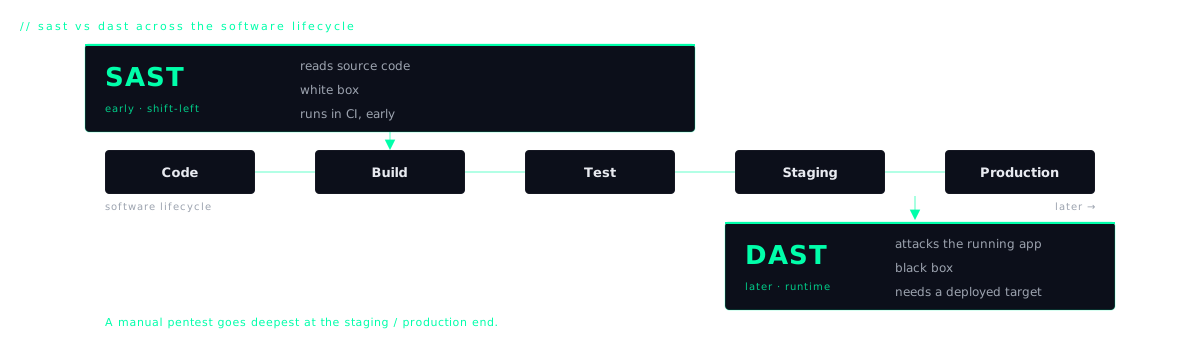
SAST analyses your source code without running it. That's the "static" part: the application is never executed; the tool reads the code the way a very pedantic, very fast reviewer would. Because it needs the actual source (or compiled bytecode), SAST is inherently a white-box technique: it only works when you have full access to what you're testing.
The natural question engineers ask is "when does static application security testing happen?" The answer: early, at commit or build time. SAST lives at the left of the software development lifecycle (SDLC). You typically run it inside CI so that the moment a developer pushes code, the scanner flags problems before they ever reach a running environment. Catching a bug at the keyboard is far cheaper than catching it after deployment, which is the whole appeal.
SAST is excellent at spotting insecure code patterns: string-concatenated SQL queries, missing output encoding that leads to XSS, weak cryptographic calls, and especially hardcoded secrets, an API key or database password committed straight into the repository. These are the kinds of issues that are obvious in the code but invisible from the outside.
The downsides are real, though. SAST is famous for false positives. It flags code paths that look dangerous but are never actually reachable, and engineers learn to tune the noise out (sometimes tuning out real findings along the way). And because it never runs the app, SAST is blind to runtime and business-logic problems: it cannot tell that two correctly written functions combine into a broken authorisation check, or that a misconfigured environment exposes a debug endpoint. It sees the code, not the behaviour.
DAST: Dynamic Application Security Testing
DAST is the mirror image. It tests the running application from the outside, with no knowledge of the source code. The tool behaves like an attacker hitting your live app over HTTP: it crawls pages, submits forms, fuzzes parameters, and watches how the application responds. Because it works against a deployed target and needs no source access, DAST is a black-box technique.
What DAST is good at is exactly what SAST misses. It finds runtime issues and misconfigurations: a missing security header, a verbose error page leaking stack traces, a default admin panel left exposed. And critically, when it reports an injection flaw, that injection actually fired against the live app. There's no guessing whether the path was reachable; the tool reached it. That makes DAST findings concrete and demonstrable in a way SAST findings often aren't.
Its blind spots come from the same place. DAST only covers the paths it can reach. If the crawler never discovers an endpoint, or a feature is gated behind a complex multi-step workflow, that code is simply never tested. It has no view into the source, so it can't tell you which line is at fault, only that a request produced a suspicious response. And because you need a deployed, running application to point it at, DAST naturally lands later in the SDLC, in a staging or pre-production environment rather than at the developer's first commit.
IAST & SCA, Briefly
IAST: Interactive Application Security Testing
IAST instruments the running application from the inside. An agent sits within the app while it executes (usually while functional or DAST tests are already exercising it) and watches data flow through the code in real time. Because it sees both the request and the actual code path that handled it, IAST combines some of SAST's code-level precision with DAST's runtime accuracy, which tends to mean fewer false positives. The trade-off is that it requires deploying an agent into your runtime, so it's more involved to set up than a black-box scanner.
SCA: Software Composition Analysis
SCA scans your dependencies for known-vulnerable components. Modern apps are mostly third-party code (npm packages, Python libraries, Java JARs) and SCA inventories all of them and cross-references against public vulnerability databases (CVEs). It answers a question neither SAST nor DAST is built for: "are we shipping a library with a publicly known, already-patched flaw?" Tools like Dependabot and Renovate are SCA in practice, and it's one of the cheapest, highest-value checks you can automate.
Black Box vs White Box vs Grey Box
These three terms predate the acronym era and describe one thing: how much access and knowledge the tester is given. They apply to automated tools and human pentesters alike.
- Black box: the tester gets nothing but the target's address. No source code, no documentation, no credentials. They start exactly where a real external attacker starts: the outside. This maps neatly onto DAST and an external penetration test.
- White box: the tester gets everything: source code, architecture diagrams, admin credentials, sometimes a developer walkthrough. This is the most thorough view, and it maps onto SAST and manual secure code review.
- Grey box: the realistic middle. The tester gets some access: typically valid user accounts at a few privilege levels, maybe API documentation, but not the full source. This is what most real-world penetration tests use, because it mirrors the most common threat: an attacker who has already obtained a legitimate low-privilege account and wants to escalate.
So "black box testing in cyber security" isn't a different activity from DAST. It's the same access model described from the tester's chair instead of the tool vendor's brochure. Once you see that black-box ≈ external/DAST, white-box ≈ code-level/SAST, and grey-box is the pragmatic blend, the two vocabularies collapse into one.
SAST vs DAST: Side by Side
Here's the head-to-head that most people are really looking for when they search "SAST vs DAST":
| Dimension | SAST | DAST |
|---|---|---|
| Needs source code | Yes: white-box, reads the code directly | No: black-box, attacks the running app |
| When in the SDLC | Early: at commit/build time, in CI | Later: against a deployed staging/pre-prod build |
| Finds what | Insecure code patterns, hardcoded secrets, weak crypto calls | Runtime injection that fires, misconfigurations, exposed endpoints |
| Blind spots | Runtime behaviour and business-logic flaws | Unreached paths; can't point to the offending line |
| False-positive rate | Higher: flags unreachable or benign patterns | Lower: reported issues actually triggered |
| Who runs it | Developers, in the build pipeline | Security/QA, against a live environment |
The honest conclusion is that these aren't competitors. SAST and DAST find largely different bugs at different stages, which is exactly why mature programs run both and don't treat either as a substitute for the other.
Where Manual Penetration Testing Fits
Every tool above shares one limitation: they find the known and the obvious. A scanner is a pattern-matcher. It is superb at catching the thousandth instance of a SQL injection or a missing header, and it will do it faster and more consistently than any human. That's genuinely valuable, and you should automate all of it.
But scanners have no concept of intent. They don't understand that an "export invoices" endpoint should only return your invoices, or that a discount code shouldn't stack on itself five times, or that step three of a checkout flow trusts a price the client sent in step one. These are business-logic and access-control flaws, and they are invisible to a tool because nothing in the code or the response looks wrong. The application is doing exactly what it was written to do. It was just written to do the wrong thing.
A human penetration tester chains issues the way a real attacker does: a low-severity information leak feeds a parameter-tampering bug, which feeds a privilege escalation, which ends in full account takeover. No individual finding is critical; the chain is. This is the work that scanners cannot do and that auditors and enterprise clients specifically ask for. It's also the bulk of what we find on a real engagement. For a concrete walkthrough of the kinds of bugs a manual tester surfaces, see our breakdown of the OWASP Top 10 as it actually appears in production SaaS, and the details of how we run a web application penetration test.
Putting It Together
Application security testing isn't a single product you buy or a single box you tick. It's a layered approach: SAST catching insecure code at the keyboard, SCA flagging vulnerable dependencies, DAST hammering the running app from the outside, IAST watching from within, and a human pentester finding the logic flaws none of them can see. The acronyms describe the tools; black, white, and grey box describe the access. Once those two ideas click into place, the soup stops being soup, and you can finally tell whether the meeting was asking for the right things.