If you've just typed "what is penetration testing" into Google, you've probably also seen the phrases "vulnerability assessment", "pen test", "VAPT", and "security audit" thrown around as if they all mean the same thing. They don't. People (including a fair number of vendors) use them interchangeably, and that's exactly how buyers end up paying for the wrong thing.
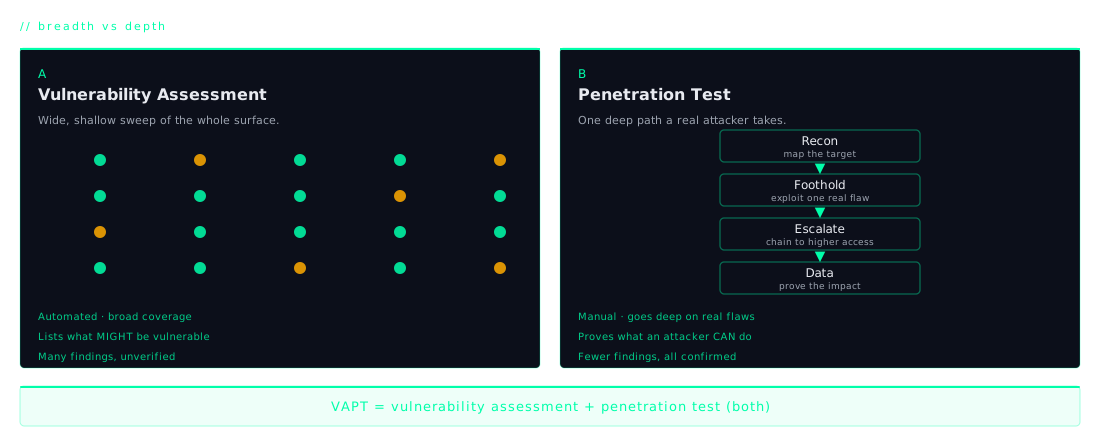
Here's the short version before we go deep. A vulnerability assessment finds weaknesses. A penetration test proves which of those weaknesses an attacker can actually use against you. One produces a list; the other produces evidence. They answer genuinely different questions, and confusing them is the most common reason a security report disappoints the people who paid for it.
And the name of this very company is a clue to how the two fit together. VAPT literally stands for Vulnerability Assessment and Penetration Testing, both halves, in that order. It isn't a fancier word for "pen test." It's the deliberate combination of breadth and depth, and by the end of this guide you'll understand exactly why serious buyers ask for both rather than one or the other.
What Is a Vulnerability Assessment?
A vulnerability assessment is a breadth-first exercise. The goal is coverage: enumerate as many known weaknesses as possible across a system, then rank them by severity so the team knows what to look at. It is largely automated. An authenticated or unauthenticated scanner (Nessus, Qualys, OpenVAS, Burp's scanner, and so on) crawls the target, fingerprints software versions, checks them against databases of known CVEs and misconfigurations, and emits a report.
What you get out the other end is a prioritised list of known weaknesses: outdated TLS ciphers, an unpatched library with a published CVE, a missing security header, a default credential, an exposed admin interface. Each finding typically carries a CVSS score so you can sort by severity. Crucially, a vulnerability assessment does not exploit anything. It tells you a door looks unlocked; it does not walk through it to see what's in the room.
That limitation is also its strength. Because scanning is fast and repeatable, a vulnerability assessment is the right tool for coverage and cadence, running it weekly or monthly across a large estate of servers, containers, and endpoints to catch the patch you missed. It is cheap, it scales, and it keeps your hygiene honest. If you want the broader picture of where this fits alongside other testing types, we cover it in our complete guide to security testing.
What Is Penetration Testing?
A penetration test is a depth-first exercise, and it is fundamentally human. Where the scanner stops at "this looks vulnerable," a penetration tester picks up the thread and asks the only question that matters to a business: so what? A person actively attempts to exploit findings, chains several minor issues into one serious one, and demonstrates the real-world impact of a compromise.
This is the part automation cannot do well. A scanner sees an endpoint that returns user data; a human notices that swapping one ID in the request returns another tenant's data, then uses that access to reach an admin function, then pivots from there into the cloud account behind it. None of those individual steps necessarily trips a scanner. The exploit lives in the logic and the chaining, and that requires judgement.
The deliverable is different too. A penetration test produces proof plus a business-impact narrative: not "CVE-XXXX-YYYY is present," but "here is the request we sent, here is the customer record we retrieved, here is how an attacker turns this into a full data breach, and here is exactly what to change." In our reports the screenshots and the reproduction steps are the point. They are what let an engineer fix the issue and what let a buyer understand the risk. If you want to see how that plays out hour by hour, we wrote a day-by-day look at a real pentest.
The Core Differences
The two activities overlap at the edges, but their goals, methods, and outputs pull in different directions. The table below is roughly how we explain the distinction to clients before scoping an engagement.
| Dimension | Vulnerability Assessment | Penetration Test |
|---|---|---|
| Goal | Find as many known weaknesses as possible | Prove which weaknesses are actually exploitable, and their impact |
| Method | Largely automated scanning | Manual, human-driven exploitation and chaining |
| Approach | Breadth: wide coverage, surface level | Depth: narrow focus, fully exploited |
| False positives | Common; findings are unverified | Near zero; every finding is confirmed by exploitation |
| Output | Prioritised list of CVEs and misconfigurations | Evidence, reproduction steps, business-impact narrative |
| Typical duration | Hours to a day, mostly unattended | Several days to a few weeks of expert effort |
| Typical cost band | Low: scanner licence or a small fee | Higher: skilled human time |
| How often to run | Continuously: weekly or monthly | Periodically: annually, or before a major release or milestone |
The single most important row is false positives. A vulnerability scanner flags anything that might be wrong, which means a meaningful fraction of its findings turn out to be noise once a human looks. A penetration tester only reports what they have actually exploited, so when a pentest says you have a critical issue, you have a critical issue. That verification is most of what you're paying the human for.
When You Need Which
Reach for a vulnerability assessment when you need continuous hygiene across a large or fast-changing estate: fleets of servers, containers that get rebuilt daily, endpoints you can't manually test one by one. Its speed and low cost are exactly what make it suitable for running on a schedule. It is your early-warning system for the patch you forgot.
Reach for a penetration test when something real is on the line. Before a product launch, when a security flaw would be expensive and public. Before a funding round, when investors run technical due diligence. And (most often, in our experience) when a customer or an auditor explicitly asks for one and won't accept a scan in its place. A pentest is what you commission when "we think it's fine" is no longer good enough and you need someone to actually try to break in.
For most regulated or enterprise contexts the honest answer is both. Compliance frameworks expect ongoing vulnerability management and periodic hands-on testing, because they're guarding against different failure modes. You can read more about how we structure these on our services overview.
So Why "VAPT"? Because You Usually Need Both
This is where the two halves come together, and why the combined term exists. A VAPT engagement runs in sequence: scan first for breadth, then put a human on the meaningful findings to verify and exploit them. The vulnerability assessment makes sure nothing obvious is missed across the whole surface; the penetration testing converts the handful of findings that matter into proven, demonstrated risk, and discards the false positives the scanner inevitably produced.
Done this way, you get the best of both. You have coverage, so you're not blind to the easy stuff. And you have depth, so the issues in your report are real, exploitable, and prioritised by genuine business impact rather than a raw CVSS number. That is precisely what serious buyers (and Western auditors in particular) expect when they ask for a security assessment. They are not asking for a scanner's PDF; they are asking for evidence that someone competent tried to break in and documented what they found. Our web application VAPT follows exactly this scan-then-exploit structure.
What Your Client or Auditor Actually Wants
When a US or EU client emails you asking for "a VAPT report" before they'll sign, it's worth being precise about what they mean. They are almost never satisfied by a raw vulnerability scan. What they want is the penetration testing depth (verified, exploited findings) plus the documented evidence: methodology, scope, reproduction steps, severity ratings, and remediation guidance, ideally with a retest to confirm the fixes landed.
This expectation is downstream of compliance. Frameworks like SOC 2 and ISO 27001 don't usually mandate a specific tool, but auditors increasingly treat an independent penetration test as the evidence that your security controls actually work under pressure, and ongoing vulnerability management as proof you maintain them between tests. A clean, well-written VAPT report is often the single artefact that unblocks an enterprise deal. Getting the wrong deliverable (a scan when they wanted a pentest) means going back and paying for it twice.
So when a buyer says VAPT, hear it literally: vulnerability assessment and penetration testing, breadth backed by depth, with the depth doing the heavy lifting on what they actually care about.
The distinction is simple once you hold it in your head. A vulnerability assessment tells you where the doors are; a penetration test walks through the unlocked ones and shows you what's behind them. Neither is "better". They answer different questions, and the mature answer for almost any business shipping software is to run both, on the cadence each is suited to. That combination is what VAPT means, and it's the standard your most demanding clients are quietly measuring you against.