An email arrives from your best prospect's procurement team. In a list of onboarding requirements sits one line: please share your most recent cybersecurity evaluation report. Everyone on the internal thread nods along. Then somebody asks what exactly to attach, and the thread goes quiet.
This plays out constantly for Pakistani software houses, fintechs, and enterprises selling into the Gulf, the UK, and the US. The phrase turns up in bank tenders, in procurement documents, and in the security questionnaire that lands two weeks before a contract is signed. It sounds like a document with a defined format that you either have or you do not.
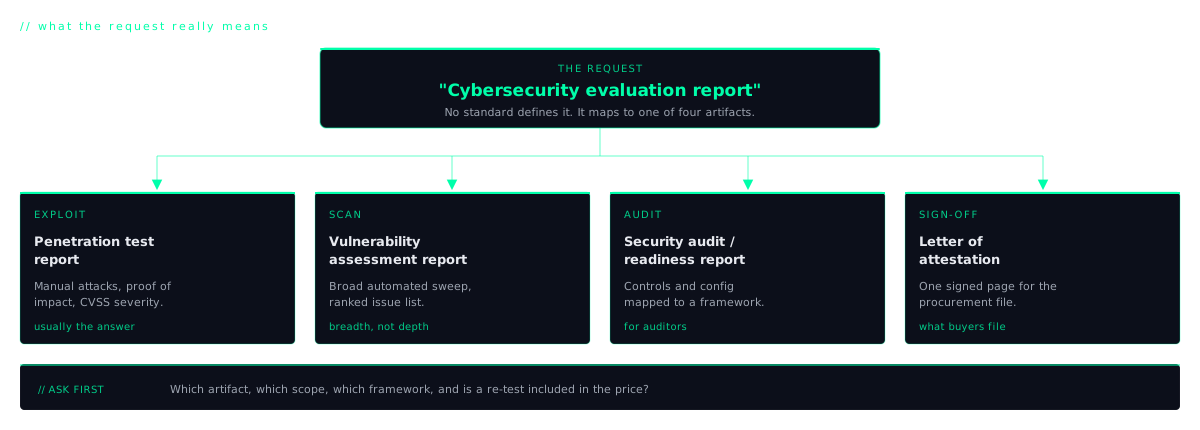
It is not. No ISO standard, regulator, or certification scheme defines an artifact called a cybersecurity evaluation report. The phrase is procurement language, not industry language, and it resolves to a small set of real deliverables. This guide covers what the term means, why buyers care enough to hold up your contract, and what genuinely drives its cost.
What a cybersecurity evaluation report actually is
A cybersecurity evaluation report is a written assessment of how secure a defined system is, produced by whoever tested or reviewed it, and structured so an outside reader can judge the result without having been in the room. That is the honest definition: it names a category of evidence, not a fixed template.
The phrase exists because whoever wrote the requirement is usually not a security engineer. They need one broad term for every kind of evidence a supplier might hold, so they write something general and leave you to work out which artifact fits. That works right up to the point where you do not know either.
When a client, bank, or tender asks for a cybersecurity evaluation report, they want one of four things.
1. A penetration test report
A qualified tester attacks your application or infrastructure the way a real adversary would, exploits what they can, and documents each issue with severity, evidence, and a fix. This is the most common answer, and it carries the most weight with buyers because it proves impact rather than listing possibilities. See our web penetration testing page.
2. A vulnerability assessment report
A broad, largely automated sweep that enumerates known weaknesses, missing patches, outdated components, and common misconfigurations, then ranks them. It is fast, cheap, and useful as a recurring hygiene check, but it cannot prove exploitability or find business logic flaws. If you are unsure which of the two you have been asked for, our breakdown of penetration testing vs vulnerability assessment covers the distinction.
3. A security audit or compliance readiness report
A review of controls, policies, and configuration against a named framework such as SOC 2, ISO 27001, or PCI DSS. The output is a gap analysis: what is in place, what is missing, and what must change before an auditor signs anything. This is usually what a compliance function is asking for. Our guide to SOC 2 vs ISO 27001 vs just a pentest explains which you actually need.
4. A letter of attestation
A one-page signed statement confirming that a named system was tested, over a stated window, using a named methodology, with the highest severity found and the remediation status. Vendor-risk teams like it because it drops into a supplier file without anyone reading eighty pages, and it is often the only thing the requester opens. We cover what overseas buyers want in your US client asked for a VAPT report.
Which one are you being asked for?
The fastest way to tell is to read the words around the phrase, not the phrase itself:
If the wording gives you nothing to go on, ask. The questions to send are at the end of this post.
What goes inside one
Whichever artifact you land on, a credible report is built from the same components:
- A one-page executive summary for management, ending on a plain verdict.
- An explicit scope statement: named URLs, IP ranges, cloud accounts, test accounts, and the test window.
- A methodology section naming recognised standards such as the OWASP Web Security Testing Guide, PTES, or NIST SP 800-115.
- Findings rated with CVSS, each naming the affected component, with reproduction steps an engineer can replay on staging.
- Business impact in the client's terms, not only the technical mechanism.
- Remediation guidance specific enough to become a ticket, ordered by priority.
- Re-test results confirming which findings were fixed and verified.
- A signed, dated attestation the buyer can file.
We keep this short deliberately: we already dissect a full report section by section in what a SOC 2-ready pentest report contains. The security audit and reporting page lists the deliverable set, and our methodology page covers the standards each phase maps to.
Why a cybersecurity evaluation report matters
The importance of a cybersecurity evaluation report is easy to underrate when you are the one paying for it, because most of its value lands somewhere other than the security team.
It unblocks the deal
This is why most Pakistani companies commission one. A UK insurer, a Dubai bank, or a US SaaS platform will not onboard a supplier who touches their data without evidence of independent testing. For a Karachi or Lahore software house competing against vendors in Eastern Europe or India, the report closes the credibility gap: it moves the conversation from trust us to here is the evidence, dated and signed. Companies with a current report clear onboarding in a day. Companies without one lose weeks arranging a test while the buyer's enthusiasm cools.
It answers auditors and questionnaires without a scramble
SOC 2 and ISO 27001 both expect periodic vulnerability assessment and penetration testing, and auditors ask for the evidence directly. Client questionnaires ask the same in their own words: date of last test, name of the provider, number of open critical findings. With a report on hand those are copy-paste answers. Without one, every questionnaire becomes a project.
It reduces the cost of the incident you have not had yet
The cheapest vulnerability is the one found privately by someone you hired. The most expensive is the one found in production by someone who did not tell you. Beyond cleanup, an incident brings downtime, penalties, notification obligations, and a reputation problem that outlasts the patch. A scheduled assessment is a predictable cost that displaces an unpredictable one.
It gives developers a ranked list instead of an argument
Engineering teams rarely disagree that security matters. They disagree about what to fix first, this sprint, against a roadmap that is already full. Severity ratings, business impact, and reproduction steps settle that, turning a vague concern into tickets with owners.
It is the evidence boards and insurers ask for
Cyber insurers increasingly ask about testing cadence at renewal, and boards want something more concrete than a status update. A dated report showing fewer criticals this year than last reads clearly to a non-technical audience.
What a cybersecurity evaluation report costs
Cost is driven almost entirely by how many hours of skilled human attention the assessment needs. Everything below is a proxy for that. We do not publish fixed prices, because a quote made without a scoping conversation is a guess.
Scope size and application count
One web application with a handful of screens is a very different job from a platform with an admin portal, a customer app, a partner API, and a mobile client. Cost tracks distinct applications, endpoints, and user roles, because every extra role multiplies the access control surface: a four-role application is closer to four times the work of a two-role one, not twice.
Black box versus credentialed testing
Black box testing gives the tester nothing but a URL. That mirrors an anonymous attacker, but it burns time on discovery and leaves most of the authenticated application untested. Credentialed or grey box testing supplies accounts for each role and finds substantially more, because most serious findings live behind the login.
Manual depth versus automated coverage
A scanner can be pointed at a target in an hour. Manual testing of business logic, chained attacks, authorisation boundaries, and payment flows takes days, and cannot be shortened without skipping the findings that matter. This one variable explains most of the price spread between quotes.
Re-test, turnaround, and compliance mapping
Three line items to check in any quote. Is a re-test after remediation included, or billed later, and how long do you have before it expires? How quickly does the report arrive once testing ends? Does it map findings to your client's framework, with a signed attestation letter, or is that extra? A report without a re-test is half a deliverable: nobody can confirm the criticals were closed.
Typical duration ranges
Duration is the most useful proxy for scale. A focused assessment of a single web application usually runs 3 to 5 business days of testing, plus reporting time. A full scope engagement covering a web application, its API, and the surrounding cloud environment typically runs 1 to 2 weeks. A mobile client or a large network range extends that. For what those days contain, see our day-by-day breakdown of a 5-day web pentest. Cloud scoping has its own rules, covered on the cloud penetration testing page.
Why the cheapest quote is usually a scan
If one quote comes in at a small fraction of the others, the difference is almost never efficiency. It is scope, depth, or both. The usual pattern is an automated scan resold as an assessment: a tool is pointed at the target, the output is exported, a logo goes on the cover, and the document arrives in two days. They are easy to spot: hundreds of low-confidence findings, no business impact written, no named test accounts, no reproduction steps a developer could follow, and no attestation letter. A reviewer at your client's end recognises one in under a minute, and a rejected report costs you the fee, the weeks, and credibility with the buyer you were trying to impress.
How to ask for the right one
Before you commission anything, send these questions back to whoever asked for the report. One email removes almost all of the ambiguity:
- Do you want a penetration test, a vulnerability scan, or a compliance gap assessment?
- Must it be performed by an independent third party, or is internal testing acceptable?
- Which systems are in scope: the production application, the API, the mobile app, the cloud environment, or all?
- Is there a framework the findings must map to, such as SOC 2 or ISO 27001?
- How recent must the report be? Many buyers accept twelve months, some require six.
- Do you need the full technical report, or a summary attestation letter for your vendor file?
- Do you require evidence that critical findings were remediated and re-tested?
Then take those answers to your testing provider. One who scopes properly will ask a further set of questions before quoting, which is a good sign. Ours are published in the 17 questions we ask before quoting.
Frequently asked questions
How long is a cybersecurity evaluation report valid?
There is no formal expiry date, but most enterprise buyers and auditors treat a report as current for twelve months from the test date, and some ask for one no older than six. It also goes stale early if the system changed materially, for example a major release or a cloud migration. Testing a version of the application that no longer exists is evidence of nothing.
Do we need a new one every year?
In practice yes, if you sell to enterprises or hold a SOC 2 or ISO 27001 certification. Both expect periodic testing, and most onboarding portals ask for the date of your last assessment. Companies that ship frequently run one full annual assessment plus lighter tests when a significant feature goes live.
Who signs the report?
The testing provider signs it, not the company being tested. A credible report names the lead tester, carries a company signature and date on letterhead, and states the test window. A self assessment by your own team is useful internally, but it will not satisfy anyone who asked for independent evaluation, for the same reason nobody accepts a reference you wrote about yourself.
Is an automated scan report enough?
Sometimes, if the requester only wants evidence that you scan regularly and patch what turns up. It is not enough when the request mentions penetration testing, manual testing, exploitation, or an independent third party, because scanners cannot test business logic, authorisation between roles, or chained attacks. Reviewers recognise raw scanner exports quickly and send them back.
The short version
A cybersecurity evaluation report is a category, not a standard. Decode the request first: sending a scan output when the buyer wanted an independent penetration test wastes a month. Ask which artifact, which scope, which framework, and whether a re-test is included, then buy the depth the situation needs.