"Send us your SOC 2." "Do you have ISO 27001?" "We just need a pentest report." Three emails. Three different US/UK clients. The same Pakistani founder reading them at 11pm, Googling "SOC 2 Pakistan price" and quietly panicking. We've sat with enough founders through this exact moment to know how it plays out. Somebody quotes you forty thousand dollars for SOC 2, you ghost the procurement person at the client, and the deal dies. That doesn't have to happen.
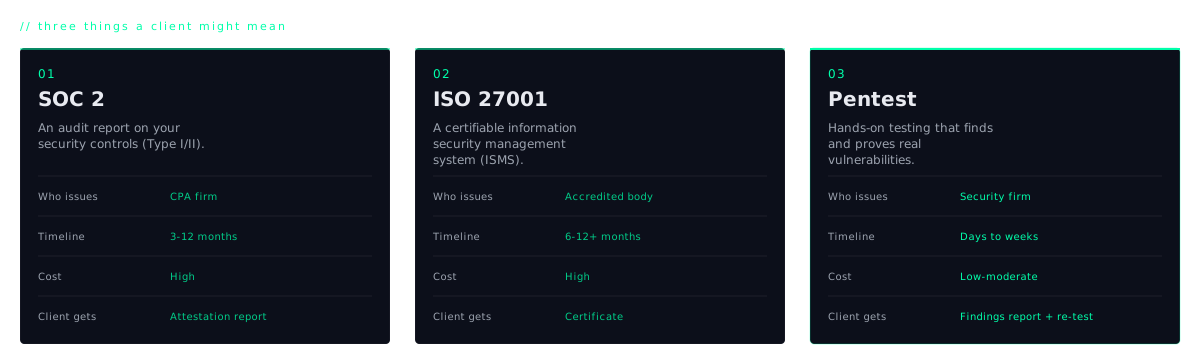
Here's the truth nobody tells small dev shops: SOC 2, ISO 27001, and a pentest are three completely different things. They have different costs, different timelines, different validity periods, and they're produced by different kinds of firms. And most of the time, most of the time, the client doesn't actually need the heavy ones. They just need a piece of paper that says someone independent looked at your security and didn't find anything broken.
This post explains what each one is, what each costs (rough US ballparks, not guaranteed pricing), how long each takes, and which one your particular client probably actually needs. If you've ever received a vendor security questionnaire and felt the panic rise. Read this first.
The 30-second version
If you only read this section, you'll already make a better decision than 80% of founders in this position:
- Pentest report: 1–2 weeks. Rough US ballpark: $2K–$15K. Valid 12 months. It's about your product. We help with this.
- SOC 2 Type I: 2–3 months. Rough US ballpark: $20K–$40K all-in. Valid 12 months. It's about your processes on a single date. Done by a CPA firm.
- SOC 2 Type II: 6–12 months of audit period + roughly $25K–$50K. Valid 12 months. It's about your processes working over time.
- ISO 27001: 4–9 months. Rough US ballpark: $15K–$40K. Certificate valid 3 years with annual surveillance audits. The international equivalent of SOC 2.
And the single most important sentence in this whole post: if your client said "pentest report", send a pentest report. Don't volunteer SOC 2. You'd be amazed how often founders escalate themselves into a six-figure compliance program when the client only asked for a one-page letter of attestation.
Pentest: what it actually is
A penetration test is exactly what it sounds like. An independent security team tries to break your product (web app, mobile app, API, cloud setup), writes up what they found, fixes are made, and they sign a letter of attestation saying "we tested it, here's what we found, here's what was remediated." That letter, plus a redacted executive summary, is what your client wants to see.
The cost varies based on scope. One small web app is a different engagement from web + iOS + Android + AWS infrastructure. The deliverable also matters. A technical report is fine for internal use, but for client-facing evidence you want a clean executive summary that a non-technical procurement reviewer can read without panicking. We covered exactly what overseas buyers expect to see in a pentest deliverable in this companion post on the US client VAPT report. If you have a deal pending, read that one too.
Key point: a pentest is about the system, not the company. It doesn't say anything about your HR processes, your access reviews, or whether your laptops are encrypted. It just says your app doesn't get owned by the first kid with Burp Suite.
SOC 2 Type I vs Type II: what changes
SOC 2 is a framework run by the AICPA (yes, the American accountants' body) for evaluating a service organisation's controls. There are two flavours, and the difference matters:
- SOC 2 Type I says: "as of this specific date, the company has these controls written down and in place." It's a snapshot. You can pass a Type I audit a few weeks after you finish writing your policies, if those policies are real.
- SOC 2 Type II says: "these controls actually worked, continuously, for the last 6–12 months." It's a track record. You can't fake this: the auditor pulls samples across the whole period and checks evidence.
Type II is the one US enterprise clients ask for once they get serious. Type I is sometimes accepted by smaller startups buying from you, especially if you commit to a Type II audit on a stated timeline. Both require a CPA firm: you cannot self-certify SOC 2. And here's a useful fact for our purposes: a recent pentest is almost always one of the evidence items the auditor requires for the CC7.1 control around system monitoring and vulnerability management. So even on the SOC 2 path, the pentest is part of it.
ISO 27001: when it's better than SOC 2
ISO 27001 is the international standard for information security management. It's older, more global, and structurally a bit different. Where SOC 2 is largely US-centric, ISO 27001 is what European, Middle Eastern, and a lot of Asian buyers will ask for. For a Saudi or UAE government deal, ISO 27001 carries far more weight than SOC 2 ever will.
A few practical differences for a Pakistani software house deciding between the two:
- The ISO certificate is valid for 3 years, with lighter annual "surveillance" audits in between. SOC 2 attestations are essentially yearly. Amortised over time, ISO can be cheaper.
- ISO 27001 is fundamentally about the organisation, not just one product. You build an Information Security Management System (an ISMS): written policies, risk register, asset inventory, incident response plan, and the auditor verifies you actually run it.
- Pakistan has accredited certification bodies. You don't need to fly anyone in from Europe. That's an underrated cost factor.
- The mapping to Annex A controls (especially A.12.6.1 on vulnerability management) means a yearly pentest report from us is direct evidence the certifier will accept.
The honest answer: what most Pakistani dev shops actually need
This is the section nobody else will write, so we will. After a couple of years of doing this work for founders in Lahore, Karachi, Islamabad, and Rawalpindi, here's the honest pattern:
- If you're under 30 people and selling to small US SaaS startups: a pentest report plus a signed letter of attestation gets you 80% of deals. Save your money. Don't start a SOC 2 program until a client explicitly demands it in writing.
- If your client is Fortune 1000 or regulated (healthcare, fintech, insurance, government): they will eventually require SOC 2 Type II. Start working toward it, but ship the pentest report now to unblock the immediate sale. Procurement will accept "pentest in hand, SOC 2 in progress" almost every time if you can show real movement.
- If you're selling to European clients, or Saudi / UAE government or enterprise: ISO 27001 is the better long-term investment. SOC 2 will mean less to those buyers.
- Don't pursue both SOC 2 and ISO 27001 at the same time. Pick one, get it, then add the other later if the market demands it. We've watched founders try to do both in parallel and burn the better part of a year on policy work instead of revenue.
The order to do them in (if your business is growing)
If you're trying to plan twelve or eighteen months out, the sensible sequence is:
- Get a yearly pentest now. This is the single highest-leverage thing you can do. It unblocks immediate deals and produces evidence both SOC 2 and ISO 27001 will require later.
- Build internal security policies. Access control, incident response, backup, vendor management, acceptable use, data classification. Even a small dev shop needs these on paper. They become SOC 2 and ISO evidence later, and they cost almost nothing to draft.
- If targeting US enterprise, start SOC 2 Type I, then Type II. Type I gets you a deliverable in 2–3 months. The Type II audit period starts running concurrently.
- If targeting EU or Middle East, pursue ISO 27001. Plan 4–9 months from kickoff to certificate.
- Repeat the pentest annually. Both SOC 2 and ISO 27001 require it as ongoing evidence. Same scope or expanded scope, your call.
What we can help with (and what we can't)
We want to be specific about this because the lines matter, and frankly because clients sometimes assume we do everything.
What we do: independent penetration testing, signed letter of attestation, security audit and reporting deliverables that map cleanly to SOC 2 (CC6.x access controls, CC7.1 system monitoring) and ISO 27001 (Annex A.12.6.1 vulnerability management, A.14.2.8 system security testing) controls. Full details on the Security Audit & Reporting service page.
What we don't: we do not issue SOC 2 attestations: that requires a CPA firm. We do not issue ISO 27001 certificates: that requires an accredited certification body. We can refer you to ones we've worked alongside.
This separation is deliberate. Auditor independence matters. If we issued certificates, our own pentest reports wouldn't be usable as independent evidence for the same client. By staying on the pentest side of the line, our reports are accepted as evidence by every CPA firm and every certification body we've encountered.
One more thing: the "we have a SOC 2 in progress" email
Here's a real situation that comes up constantly. You're three months into a SOC 2 Type I program. A client emails today asking for evidence. You don't have the attestation yet. What do you send?
You send three things:
- The pentest report you already have (or get one fast: two weeks is doable).
- A short compliance roadmap letter on your letterhead saying "SOC 2 Type I in progress with [CPA firm], expected attestation date [month/year], current audit phase [readiness / fieldwork / report]."
- Your current internal security policy pack: access control, incident response, data handling. Whatever you've written so far.
Most clients accept this combination if you're transparent. The cardinal sin is to ghost the procurement person. They have a job to do (fill out a vendor risk row in a spreadsheet), and silence forces them to mark you as "no response." A founder who over-communicates almost always beats a founder who waits until "everything is perfect."
The same principle applies if a client asks for ISO 27001 and you're not certified. Send the pentest, send the policies, send the roadmap. The deal usually survives.